
The prayer times in Nantes are not uniform from one site to another. The difference between two platforms can reach several minutes for the same salat, depending on the calculation convention used. Understanding these differences allows you to choose a reliable source and stick to it.
Calculation Methods and Differences Between Platforms for Prayer Times in Nantes
The latitude of Nantes (approximately 47.22° N) places the city in a zone where seasonal variations in brightness strongly influence the calculation of Fajr and Isha. The angles used for these two prayers differ according to the conventions applied by each platform.
The convention of the Union of Islamic Organizations of France (UOIF) is the most widespread on sites intended for Muslims in France. Other platforms use different references, which shifts the displayed times by a few minutes, sometimes more in summer when the astronomical night is short.
The angle chosen for Fajr and Isha is the primary cause of discrepancies between calendars. A site that applies an angle of 18° for Isha will display a later time than a site using 15°. Similarly, the convention used for calculating Asr (Shafi’i or Hanafi school) modifies the time of this prayer. These divergences are not errors: they reflect distinct jurisprudential choices.
We recommend systematically checking which calculation method a site applies before adopting it as a daily reference. This information is usually found at the bottom of the page or in the calendar settings.
Adhan, iqama, and Online Times: What Each Data Means
A calendar calculated for the city of Nantes provides the time of the adhan, which is the moment when the prayer becomes valid according to the position of the sun. Consulting the prayer times in Nantes on Geopolitis allows you to quickly find these references, but it is important to distinguish this data from that displayed by a specific mosque.
The iqama is the call that marks the actual start of the collective prayer. It is set by the imam of each mosque and can occur ten, fifteen, or twenty minutes after the adhan. A faithful who relies solely on an online calendar risks arriving either too early or after the start of the group salat.
On the Mawaqit platform, the pages dedicated to Nantes mosques display both the time of the adhan and that of the iqama. This is a technical point that generic calendars do not cover, as they limit themselves to astronomical calculations without integrating local practices.

Seasonal Variations in Prayer Times in Nantes
The position of Nantes, slightly west of Paris, shifts the prayer times compared to the capital. This shift is permanent, but its amplitude varies with the season.
In summer, Fajr can occur very early in the morning while Maghrib is in the late evening. In winter, the window between Dhuhr and Asr narrows considerably, and Isha arrives relatively early. These fluctuations make a monthly calendar more useful than a simple day-to-day consultation.
A downloadable monthly calendar avoids the need to check each morning. Several platforms offer a complete table for the current month, with the six time markers: Fajr, Chourouk, Dhuhr, Asr, Maghrib, and Isha. Printing this calendar or saving it on your phone covers most needs.
Choosing the Right Platform to Consult Prayer Times in Nantes
Not all platforms are equal. Here are the criteria that distinguish a reliable source from a simple aggregator:
- The calculation method is clearly indicated and modifiable. A site that does not specify the convention used does not allow for cross-referencing the information.
- The geographical coordinates accurately correspond to Nantes (latitude 47.22° N, longitude -1.55° E). Some services geolocate the user but display the times of a neighboring city by default.
- The distinction between adhan and iqama is present for local mosques, confirming that the site integrates field data and not just an algorithm.
- Mobile notifications work offline after initial setup, an advantage for not depending on a constant connection.
Among the most used platforms for Nantes, Mawaqit stands out for its direct link with the mosques that update their iqama times themselves. Calendars like Guide Musulman or Awqati offer a complete monthly view with the possibility to change the calculation convention.
Nantes Mosques and Specific Times
The Grand Mosque of Nantes (mosque Assalam) publishes its times directly on Mawaqit. This page serves as the reference for faithful who pray in congregation at this location, as it incorporates adjustments decided by the mosque’s management.
Other prayer rooms in Nantes also have dedicated pages on this platform. Each mosque sets its own iqama times independently of the astronomical calendar. Two mosques located in the same neighborhood may therefore have different collective prayer times by several minutes.
For Friday prayers (Jumu’a), the time is often fixed throughout the year or adjusted twice a year during the time changes. Checking the page of the concerned mosque remains the only reliable method.
Understanding the Qibla Direction from Nantes
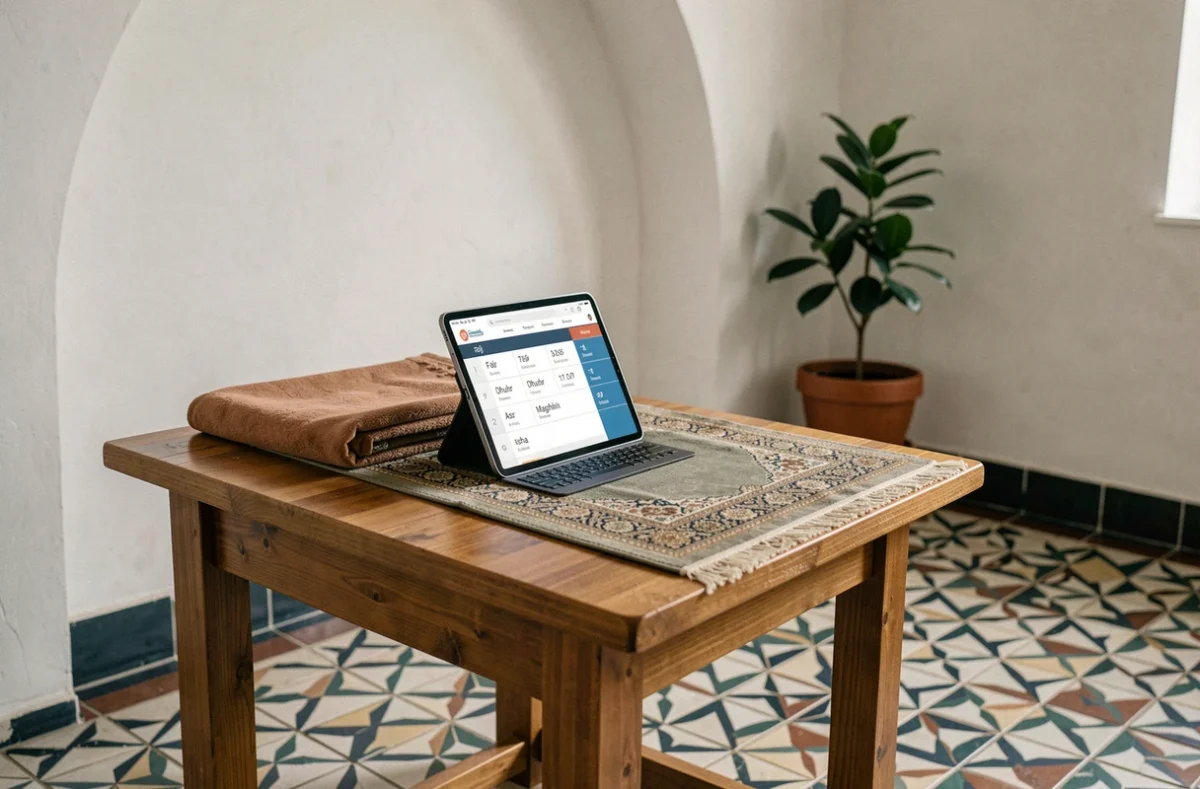
The Qibla from Nantes points southeast. Prayer applications generally include a compass that indicates this direction in real-time using the phone’s magnetic sensor.
For a fixed installation (prayer mat in an office, prayer room in a company), a one-time check is sufficient. Platforms like Awqati display a precise azimuth calculated from the geographical coordinates of the city.
The prayer times in Nantes vary according to the season, the calculation method, and the mosque attended. Cross-referencing a reliable astronomical calendar with the page of your local mosque remains the safest combination to never miss a salat.