
Each country sets its own documentary requirements for the entry of a minor into its territory. A child, regardless of age, needs their own identity or travel documents: they have not been included on their parents’ passport in France for several years. Before packing the bags, the priority remains to check the validity and exact nature of the required documents according to the destination.
Distinction between child and unaccompanied minor in air regulations
Regulation EU 2026/2202, published on October 2, 2026, in the European Official Journal, introduces an operational distinction that changes the way to prepare for air travel. The text defines the child as a person under 14 years old on the date of departure. The unaccompanied minor refers to any person under 18 traveling without a responsible adult and taken care of by the airline.
This difference is not cosmetic. It modifies the booking and accompaniment obligations imposed on carriers. For a child under 14, the airline is systematically informed of their presence when their date of birth is provided at the time of booking.
For an unaccompanied minor (between 14 and 17 traveling alone), the care must be formalized with the legal guardian. The forms vary from one airline to another, but the European framework now imposes this formality. Checking the required documents on Concept Voyages allows for precise identification of the expected documents according to the traveler’s profile and destination.
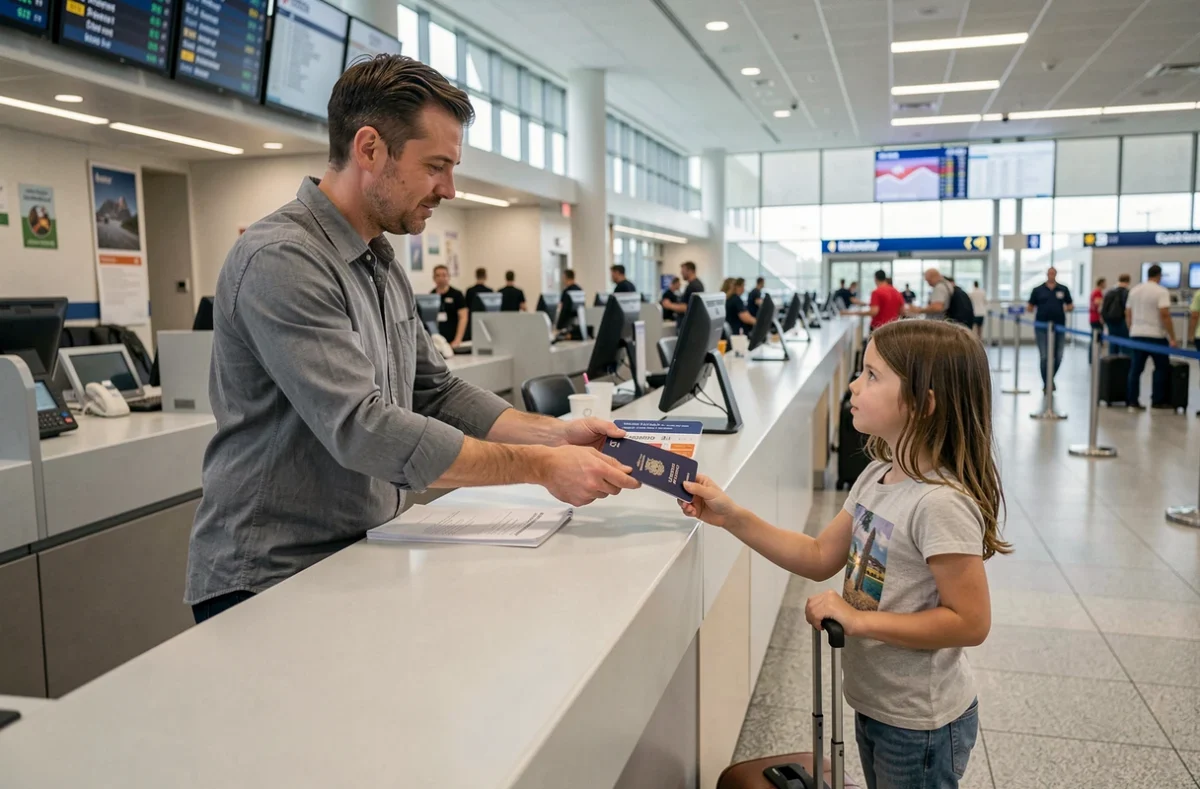
ID card or passport: which identity document according to the destination
Within the European Union and the Schengen area, a valid national identity card is sufficient for a French child, even an infant. The card must be in the child’s name. No mention on the parents’ card replaces this individual document.
Outside Europe, the passport becomes the rule. Some countries require that the passport be valid for six months after the planned return date. Others demand a specific visa for minors, sometimes distinct from that of adults.
Check the actual validity of the identity card
France has extended the validity period of identity cards issued to adults, but this extension does not apply in the same way to minors. A card issued to a child under 15 remains valid for five years. Therefore, it is necessary to check the actual expiration date, not simply assume that the card is still valid.
Some countries do not recognize cards with an expired printed date, even if France still considers them valid for adults. Check the printed date on the child’s document, not that of the parent.
Authorization to leave the territory for a child traveling without both parents
Since 2017, a French minor leaving the national territory without being accompanied by one of their parents must present three documents simultaneously:
- Their identity document (identity card or passport according to the destination)
- The Cerfa form for authorization to leave the territory, signed by a holder of parental authority
- A copy of the identity document of the signing parent
This obligation also applies when the child is traveling with a grandparent, an uncle, or a family friend. The Cerfa form is free and can be downloaded from the Service-Public.fr website. The absence of this document may lead to a boarding refusal.
Particular cases related to parental authority
In the case of separation or divorce, the signing parent must hold parental authority. If one of the parents has a travel ban imposed by a judge, the authorization of the other parent is not sufficient to lift this measure.
For blended families, the stepparent does not have parental authority by default. The form must be signed by a legally recognized biological or adoptive parent.

Stroller on the plane: what the European regulation of 2027 changes
The same European regulation (EU 2026/2202) provides a concrete evolution for families traveling with young children. Starting from October 23, 2027, airlines must, except for security or operational constraints, transport the stroller free of charge to the boarding gate or the plane and return it to the same place.
Currently, practices vary widely. Some airlines allow the stroller at the aircraft door, while others check it in the hold right from the counter. This harmonization will simplify logistics, but it will not come into effect until the end of 2027. Until then, each airline retains its own rules.
Air booking and child’s date of birth
The child’s date of birth has become an operational data point during booking. Providing this information at the time of ticket purchase allows the airline to adapt its services: assigning a bassinet in the cabin for an infant, suitable seating, child meals.
Not providing this information can complicate check-in on the day of departure, or even lead to a refusal if the carrier considers that the care has not been anticipated.
Insurance and medical documents: what to prepare for a child
The European Health Insurance Card (EHIC) covers medical care in the EU and some associated countries. Each family member, including each child, must have their own card. The application is made online with the Health Insurance, ideally several weeks before departure.
Outside Europe, travel insurance covering medical expenses and repatriation is highly recommended. Contracts linked to bank cards sometimes cover children, but limits and exclusions vary. Reviewing the general conditions before departure avoids unpleasant surprises.
- Health record or copy of vaccination pages, especially for destinations requiring certain vaccines
- Valid prescription if the child is undergoing medical treatment
- Individual European Health Insurance Card for each child
- Travel insurance certificate if the destination is outside the EU
The health record is not a mandatory document at borders, but it remains useful in case of medical consultation abroad. Bring a copy rather than the original to limit the risk of loss.
The documentary preparation for a trip with a child relies on three pillars: identity (individual ID card or passport), parental authorization (as soon as both parents are not present), and health coverage suitable for the destination. The European regulation of 2026 adds a layer of formality for air travel, with age definitions that directly influence booking procedures. Anticipating these checks by a few weeks remains the most reliable way to avoid a blockage at the airport.